Monday, February 25, 2013

That's Not Natural

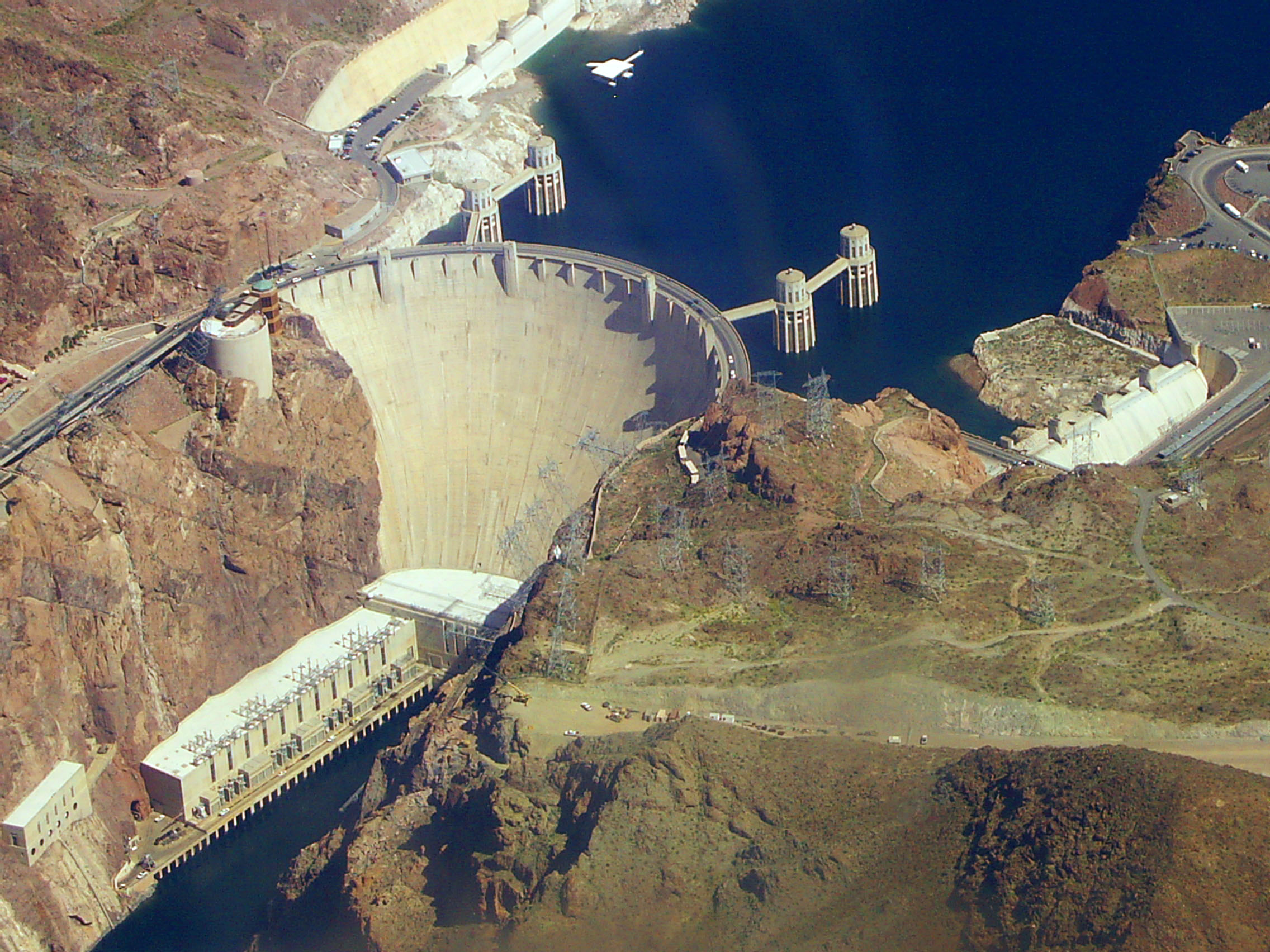
Here's a dam:

(Image from: http://en.wikipedia.org/wiki/File:Hoover_dam_from_air.jpg)


Here's another one:

(Image from: http://www.newswise.com/articles/beavers-dam-good-for-songbirds)

What differentiates the two? There are some obvious answers, like scale and building materials. There is, however, another answer that I think many people would give, and which I would argue isn't actually correct: one of these is natural and the other is not. 

I disagree. I think they're both natural. In fact, in one sense, everything is natural. It is not possible for anything to be unnatural, because if it were, it wouldn't exist. Of course, this isn't, strictly speaking, the most accurate definition. But the nuance takes some time to explain. In the end, I want my reader to walk away thinking, "it's not useful to label things as natural or unnatural based solely on my gut reaction."

Wait, before you object, hear me out. This is initially going to sound like splitting hairs, but I think there are some very good reasons to reconsider our assumptions about what is natural and what is not. We often make judgements on whether something is good or bad based on snap assessments of whether or not that thing seems natural. But this is not a precise way of thinking, and doesn't let us understand the real reason something is "good" or "bad." If we want to be able to judge the value of our own behaviors, let us do it on a more solid understanding of the thing itself, not whether we feel that it's either natural or unnatural. It's too easy to get trapped in circular reasoning with this sort of thing. Why is this good? It's natural. What makes it natural? It feels good. What makes it feel good? It's so natural.

...

Most dictionary definitions of the word, "natural," include something like, "not caused or created by humans." While it is unarguably true that there exists "that which humans created and that which we did not," this definition creates a nice, neat, clean, and completely wrong-headed separation between humanity and nature. 

This way of thinking probably has numerous origins, such as certain religious dogmas, the lengths that human beings specifically and (seemingly) consciously manipulate our surroundings to make ourselves physically removed/remote/insulated/safe from them, and undoubtedly, the way our brains are wired to perceive the world. In other words, to some extent, it's possible that we can't help but automatically see ourselves as separate from the "natural" world. We see two spheres of existence: the natural, and the human (or, by definition, the unnatural). Them and us. Like us and not. 

The truth, of course, is that we are as much a part of nature, and as connected to it, as anything else on the planet. This seems childishly obvious, but it's easy to forget, especially if you happen to live in one of our concrete jungles and you never really spend time away from the city. Our particular development path, the western development path, lends itself to a very specific type of remoteness, where we're all several steps removed from the natural processes on which we rely. I don't necessarily see this as a problem, and this post is decidedly NOT about a need to "tear down civilization," but I do want to point out how the way we live influences our perception of what is natural. It's easier to feel like we're separate from the natural world when we're so far away from it in so many ways. 

The point is that the dictionary is insufficient when it comes to thinking about natural and unnatural. 

Back to the dams.

The beaver dam is natural. No arguments there. 

What about the Hoover Dam? Not natural? Why not? 

Well, because humans created it. Because of the scale. Because it fundamentally throws the entire surrounding ecosystem into a radically different equilibrium, and probably destroys a bunch of existing ecological niches in the process. These statements are all true, but I don't think that they make the Hoover Dam unnatural.

First, the existence of humans, the fact that we're here, is natural. We came to exist as a product of the same processes that created everything else. If you disagree with that assertion, then you may as well stop reading. 

The point is that some things that people do are considered natural, even though this wouldn't fit the dictionary definition of the word. I don't think that there's anything fundamentally unnatural with, say, building shelter. Animals do it all the time. Would a lean-to seem unnatural? What about a house in the suburbs? Does one seem more natural than the other? 

Here are the only differences between a lean-to and a house, between a beaver dam and the Hoover Dam: size, complexity, and the scale of the effects on the surrounding environment. It doesn't make sense to say that a behavior becomes unnatural when it passes a certain threshold in scale, nor do I think it makes sense to assert that some of our behaviors are natural and some are not. In the same way that a fox does what a fox does, humans do what humans do. Sure, the magnitude of the repercussions from our behavior is much greater, but that doesn't make our behavior unnatural. In summary, the simple fact of being human is not enough to make our behavior unnatural.

To address the topic of scale, consider the Gros Ventre landslide area near Jackson Hole. In the picture below, that enormous brown gash in the mountainside is where fifty million cubic yards of earth and rocks and trees used to reside. In 1925, due to heavy precipitation, that entire area relocated. Human action was in no way involved. I was there last summer, and you can still see where all that material used to be. The rubble blankets a gigantic area across the valley, even reaching up the slopes of the mountain opposite.  
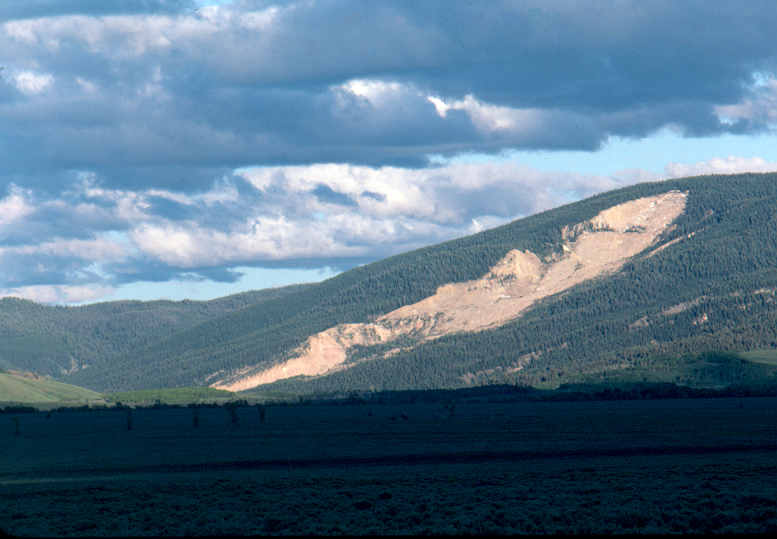
(Image from: http://www.nps.gov/grte/images/20091204133959.jpg)

The landslide created what are now called the Slide Lakes, seen in the image below. This picture was taken further up the valley from the picture above, facing the opposite direction. You can sort of make out the brown slide area stretching across the left side of the picture. Prior to the slide, the Gros Ventre river flowed unobstructed through the valley. I tried to find flow-rate data to give some idea of the river's size, but it wasn't available. As a very very very rough estimate, it's about 4 times the size of Boulder Creek during the spring runoff. 

   
(Image from: http://www.jacksonholenet.com/lakes_rivers_falls/slide_lakes.php)

I don't know anyone who would argue that this landslide was unnatural, but the scale of the effects on the environment certainly rival that of many man-made dams. Clearly, it's not enough to argue that we affect the environment in a much bigger way than it would otherwise be affected if humans didn't exist. 

Another potential way to define "unnatural" is to say that it throws off pre-existing equilibria. In response, natural processes recalibrate their equilibriums constantly; this happens whether humans are around or not. 

So this leads us perhaps to the crux of the argument: would something happen if we took humans out of the equation? I think that many people like to use this question as the basic litmus test of naturalness. But if you agree that the existence of humans is natural, then this question is a logical fallacy. As long as the existence of humans is as natural as the existence of foxes (or what have you), then it doesn't make sense to ask that question. For example, we wouldn't ask, "would such-and-such still be natural if foxes didn't exist?" It's a moot point, because we automatically assume that since foxes are part of the "natural world," everything a fox does is natural. 

But wait. Let's think about this a little more deeply.

To be fair, there's a little leeway here. If a fox started trying to survive by eating only grass seed, then we might say that it was behaving "unnaturally." But what does that mean? Only that it was behaving in a way that is 1) inconsistent with what we expect based on observing the behavior of other foxes, and 2) detrimental to its own interests, that is, its own survival.

A HA! Here is the one place where I think it's acceptable to apply the word, "unnatural." 

Something is unnatural only if it's a self-inflicted action that directly inhibits our own ability to survive, and produces effects that cannot be mitigated/counteracted by reaching some new equilibrium.

But here's the kicker: such an action will, inevitably, stop. It literally cannot continue in the long run. The environment will force it to stop. This is why we so rarely see anything happening in nature that we'd characterize as "unnatural." Natural selection/environmental pressures stamped it out before we could notice. In this way, in the long run, everything that exists is natural, because if it weren't, it would be forced to end. 

This is the only reliable way to gauge what is unnatural, but we automatically apply the term to a wide range of things that don't, in my opinion, deserved to be labeled as such. 

The main problem I see is that we're not very good at deciding which of our behaviors are fundamentally "ok," or "good" (for our survival), and which are "not ok," or "bad." There are probably numerous things we do that we think are good, natural, and healthy (but aren't), and vice versa. I'm not sure that most people would call the process of synthesizing penicillin and putting it into little plastic pills "natural," but on the whole, that practice seems pretty useful for our survival. 

To truly know whether we're enhancing our nest or fouling it, sometimes it's not enough to go with our gut feelings and call things natural or unnatural. Instead, we must do our best to realize how little we understand of the complexities of our environment, and wait to pass judgement until we understand the degree to which environmental equilibria will shift given a certain action, and whether we're prepared to accept (or even able to survive) the consequences of that shift.

Wednesday, February 20, 2013

Wasn't High, Just Tired

I wrote this very strange entry in the notepad function on my iphone. I think it deserves its own post. It's dense, and offers no real conclusions.

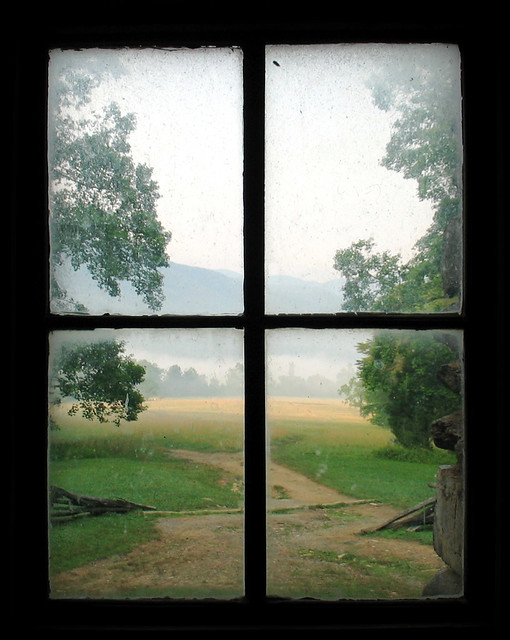
Sometimes I wonder if perhaps my window isn't actually a window, but is instead a canvas. It does not show me the world as it is beyond the glass, but rather a twilight treescape, an unchanging drawing from the head of a person who knows what should be out there, but who has no originality. I am in a room that shows me illusions of the outside world, and I can't tell if my canvas windows reveal the world or hide it.


(image from: http://farm2.staticflickr.com/1393/1414205324_a5642d31ea_z.jpg)

The longer I live, the less this question seems to matter. I can only perceive what the window lets in, and though the window's conveyance may be true, my own perception, with all its biases, assumptions, and other complexities will inevitably distort my perception, to the point where what I see is never what's really there. It's a disconcerting thought, to realize that my own senses could be so unreliable as to be unable to accurately represent even a simple view from a window, contrived though it may be.

Suppose then that my windows truly are only canvas stretched over my walls. They could be remarkably detailed representations of the outside, exact replicas, in fact, but despite all appearances, they are not actually made from panes of glass. Imagine yourself in this room; do you feel trapped, knowing that the windows are fake? Would you feel more trapped, the truer the image became? Would a child's drawing of a single tree on a  background convey the same feeling of quiet discomfort as being in a room with the more accurate recreations?

Or would you prefer no windows at all, just four, blank, white walls if given the choice? Is a simulated world, a fake but very detailed world, better than a real but drab one? And what if that simulation approaches reality to such an extent as for the two to be indistinguishable? I have another kind of window, one that seems to convey the world with near perfect fidelity. The television engages my sight and my hearing, two of the most important senses for engaging with the world. It seems unnecessary to support the claim that sometimes we prefer illusion to reality, much as some may reflexively deny it. Yet, I think I would give up TV for all time, if the alternative were to never again be allowed to gaze out my window on the quiet, mundane, occasionally tragic, but very real world beyond it.

Saturday, January 12, 2013

Nuts and Bolts

I hate the fact that I find a new error every time I go through something I've written. The most annoying part is that it doesn't seem to matter how many times I look at it. Or even, how many times I have other people look at it. There's always another mistake, or another line that needs to be rewritten, or another sentence that should be added/deleted for clarity's sake.

This highlights my desire to make my writing perfect. Of course, this is probably impossible. Sure, it can be devoid of typos and filled with competently-worded sentences, but will something ever be perfect? Is Ender's Game perfect? In some respects, yes; for all practical purposes, it may as well be; technically, no it's not.

It's incredibly difficult to separate the idea that a technically perfect piece of writing is somehow linked to my skill as a writer. Perhaps it isn't; nevertheless, I get immediately crabby about a piece of writing that I'm editing if there are mistakes all over the place. It could be a good story, but these mistakes get in the way. They subtract from my estimation of the submission, in much the same way a typo in a resume might kill the applicant's chance at getting an interview. Unless, of course, the applicant's credentials are too incredible to ignore.

Ultimately I guess it comes down to striking a balance; are there few enough mistakes in your good-enough story?

I think it's pretty difficult to separate what matters from what doesn't. This is probably true in life in general, but is especially true when we discuss what makes good writing. One problem is that there are so many examples of what we might term "good writing," and what works in one piece might not work in another. Writing skill and story, yin and yang, two parts of a whole. There is always a balance. Plus, most people use the term "good writing" to describe a range of things they like about a particular piece.

At the end of the day, I think I simply need to stop caring about whether or not I'm a "good writer." This was something that Orson Scott Card probably wanted everyone to walk away from his writing group having internalized. It's harder than it sounds, not just because my personality is like that, but because when one is looking for success at anything, not just as a hobbyist, but truly looking to become accomplished, well, it's good to be good at that thing, right?

Seems obvious, when phrased so generally, but I think this falls apart when applied to fiction writing (or perhaps when applied to any art form.) Or rather, I think it's easy to focus on the things that don't matter. Changing "a" to "the," or adding just one more sentence; these things won't make a piece of writing. The useful technical advice that fills Elements of Style make good guidelines, but that book should be termed Elements of Grammatically Correct and Essentially Clear Writing. It most certainly should not include the word "Style." I think it's style that defines a fiction writer, and style is something that can be very hard to define. It's comprised of many things: word choice, word order, rythm, flow, content, form, etc. Can you teach these things? Each thing on its own, to some extent, possibly yes. Can you teach how all of these things fit together to either make or break a story, or a writer?

No.

Wednesday, December 19, 2012

Evil Restroom


Evil Restroom
Todd Camnitz
1/6/2013

Not quite drunk. His friends say he is, but he isn’t, not really. Just had a little. Feels wobbly, sure, but drunk? Nope. “Go head, guys,” he says. “I’ll catch up at the bar.” Really has to go. Doesn’t want to wait.
He teeters into a park’s public restroom, and nearly promotes his innards to outards, right there on the floor. Had more than he thought. But not drunk. Buzzed. Yeah. That’s the word. That’s what his ex, Sarah, always said, trying to placate him the next morning. “It was a great party! But don’t worry, I only got buzzed,” she’d say, while holding her head and popping hangover pills. Smooth the truth. Buzzed right into some other guy’s lap, no doubt.
When your girlfriend cheats on you, would you prefer for her to be drunk, or merely buzzed?
Ah, forget it. She was a liar, anyway.
Of course, there was that one time, when Sarah was out of town. That small get-together, and that little brunette; what was her name? Ashley? April? Something with A. Anomaly. Anemone. An enemy. Whatever. That made things even. Sort of. It was just a kiss; well, a few kisses, and a hand running up…hold that thought, the world is spinning…
On his knees, he barfs into a trash bin near the door. Waste of decent seafood. The floor is cold and hard and painful. He pulls the can closer. It’s heavier than it looks. The metal bottom screeches like a banshee against the concrete. A trashcan banshee. Trashcanshee. He rests his arms on the rim and the can tilts with his weight, but doesn’t fall.
Until very recently, the can was propping open the bathroom door. Freed from the hindrance, the door slams closed. The resulting breeze ruffles his hair.      
He retches once more, mostly hitting the wastebasket. Definitely not drunk now. He feels better, after a few breaths. Gets up, hands on his knees. He pulls eight paper towels—all at once—from the metal dispenser near the sink. The bathroom offers other options. There is, in addition to the dispenser on the wall, an automatic air dryer. Can’t clean his face with that. He wipes his mouth. Forgets the bits of crab still on the floor. Needs to pee.
  Out one end, then out the other. Dried urine rims the toilet bowl. Either one person had atrocious aim, or many people had not-quite-perfect aim. Regardless, there is one certainty: no one will wipe it off. Not in a public restroom. He’s not going to do it, either. People are such pigs, he thinks. He shakes a few times, clearing the last drops. All of them land on the rim.
He stumbles from the stall without flushing. One shoe nearly steps in a puddle against the back wall. A puddle from nowhere. It’s a mystery how the water (or whatever it is) got there. No drain, no window, no rivulets down the wall, no miniature creeks from under the stalls. It’s just a secluded puddle. His very own Walden Pond, on the floor in the public restroom.
A fluorescent fixture lines the top of the mirror behind the sink. It supplies unapologetically meager light, prone to epileptic fits of flickering. The soap is empty. He hits the knob on the tap (a timed-release), and a niggardly trickle falls from the faucet. The water lasts for three seconds. He swears. Pounds the knob again. Resorts to holding it down with one hand while washing the other, then switching hands. When he presses the button on the hand dryer, nothing happens, so he dries himself with another paper towel.
He turns and strides to the exit. Yanks on the vertical door handle. It detaches from the green, metal door with a loud scrunch, the noise echoing around the empty bathroom.
The light flickers.
The door stays shut. Didn’t move an inch.
He can see two, rough, metal circles where the handle had been welded to the door. In a disoriented haze, he stares at the piece of aluminum in his hand. Glances around, briefly. Still no windows. There’s a sheet of paper taped at eye-level on the back of the door. A maintenance log, apparently. If he looked at it closely, he’d see that different names appear on each line, each followed by a date. There are thirteen names. Thick, red lines skewer nine of the names and dates, left to right. Only four names have no line. The most recent date reads March 17, 2007. Five years ago. He eyes scan the page without seeing, without comprehension.
Is the puddle getting bigger?
He throws the handle into the trashcan, and it clangs against the side. When the noise fades away, the light-fixture’s faint buzzing is all he can hear. In the trash, the handle sits in a pool of…well…yeah.
He imagines a doctor, looking in the wastebasket: “I see why you threw up. Appears you tried to eat this door handle.”
He reaches to open the door some other way, but there is no other way. A dense ball of apprehension settles in his gut.
Don’t worry. He’ll get the door open.
He can’t.
A thought forms in his mind. He won’t acknowledge it, not yet. The thought stays, though, hovering. Tapping on his consciousness. Excuse me. Please, excuse me. Think me.
He’ll get it open.
Still doesn’t open.
He thinks the thought.
I’m trapped.
He’s trapped in a public restroom at two in the morning, and by now his friends will have reached the bar. The thought comes close to amusing him. Certainly this would be funny if it were happening to someone else.  
 Trapped? Really? Can’t be. Can’t actually be trapped. Not yet panicked, but more than a little perturbed, he gets down on the floor and tries to wedge his fingers under the door. It’s useless. Not enough space. He knew it would be useless before he tried. He tries grasping the tiny, metal ridges the handle left when it detached, but he can’t get a good grip. When his hand slips, the metal slices his skin. He sucks his fingertip, a couple drops of blood spattering the floor.
The door’s edges are nearly flush with the wall; there’s even less space than at the bottom. The thinnest seam.
His keys. Yes, the keys, they will help. They’ll fit between the wall and the door. He clutches them. Grips them so tightly, they leave mirror-image dimples in his skin, a pattern for opening pressed into his palm.
He manages to force a key between the wall and the left side of the door. He’ll pull, with his forefinger through the key ring, and the friction will force the door open, just enough. Then, he’ll be able to get a better grip and swing it the rest of the way. He pulls and pulls. Nothing. The key sticks for a moment, then pops out of the seam each time, the door having moved not at all. The key leaves little streaks of silver where it scratches the paint.
He kicks and pounds on the door with his fist. He yells. In the bathroom, the noise from his assault is deafening. No one comes. The door stays shut. He paces from one end of the bathroom to the other. Passes the sinks, a single urinal, two regular stalls, and finally, the handicapped stall, where he recently relieved himself. Apart from the door, there is no way to exit the restroom. There is a circular vent in the ceiling, roughly the width of his hand.  
He climbs on top of the toilet in the handicapped stall, aims he face at the vent, and yells some more. As he strains to be heard, he loses his balance and slips. One foot goes in the toilet bowl as he crashes to the cement, bruising his shin and hitting his head against the wall in the process.
Violent swearing fills the restroom. He’s laying on his back, holding his leg up to his chest, hands on his shin. Something cold and wet touches the back of his head. He jerks up. His hair is sopping wet. The puddle is spreading. He scrambles to his feet, backing away.
The liquid is dark, like molasses, and the surface is smoother than the jerk Sarah hooked up with. The edge of the puddle creeps toward him, as quietly disconcerting as an oil spill. The water in his hair is uncomfortably cold. He yanks on the roll of toilet paper to dry himself.
For no reason he can explain, the last thing he wants to do is step in the puddle. To avoid this, he crawls under the divider and into the adjoining stall. The puddle has yet to spread that far, and he makes a limping beeline for the exit. Toilet water and urine squelches in one of his shoes. With another paper towel, he gingerly plucks the aluminum handle from the trashcan. Fumbling with it, he tries to put it back where it used to be, as if by touching the sections of metal to each other, they’ll remember their old closeness and re-attach. This accomplishes nothing, and he flings the handle across the restroom with a frustrated shout.
The handle careens off the back wall and splashes into the dark water. It’s as though the puddle was just waiting to be disturbed. A dam has broken. The first ripple grows into an entirely unreasonable amount of water—a miniature tsunami—rolling violently into all four walls. It covers the floors, and the backsplash washes against his knees. His legs prickle with the chill, and he can’t see his shoes beneath the water’s surface. The water rises.
  If only he was a swimmer, like Sarah. They had understood each other so well. What happened? A great shiver runs through his body, making his teeth clack together. He misses her smile.
Why is he thinking of her? Why now?
The water level is rising even faster, and he’s hopping from one foot to the other, moving to the sinks. He clambers onto the sink nearest the first stall, and hangs onto the top of the stall divider for stability. The “puddle” reaches the sink’s rim and fills it with icy darkness.
The ceiling is too low for him to straighten up while standing in the sink, so he hunches over, watching the water once again envelop his legs.
Maybe he should call her. She’s probably asleep, but he could leave a message. He could apologize for screaming at her. For saying those awful things. He didn’t mean them. He’d been even colder to her than the water in the puddle. It reaches his waist, and the shock of it causes part of his plumbing to crawl up inside his abdomen. “The scared turtle effect,” one of his friends always called it.
How would the message go? “Sarah, I don’t know what’s about to happen to me, but I want to tell you that I … I …” Am sorry? Love you? Miss you? Forgive you? No, this is a terrible idea. He doesn’t know how he feels. The last five words he threw at her replay themselves in his mind. “I hate you. Get out!” He wishes they could have a second chance.
The water level is rising so fast that it’s nearly at his chin before he realizes he can’t leave her a message anyway; his phone is in his back pants-pocket. Submerged. His wallet is similarly inundated, and he has the wild thought that he’ll have to iron his bills if he survives. He’s rapidly running out of ceiling.
At that moment, the thought finally hits him. He could have called his friends. How could he be so stupid? Someone could have let him out. He could have called 911. He could have called anyone. In a frantic burst of possibility, he fishes the phone from his pocket. When he tries to press a button, it’s as he fears: dead. He drops it and it sinks out of sight, along with his hopes.
He claws his way to the vent and smooshes his face as close to the opening as he can. His hands and feet are completely numb, and soon there will be nothing left to breathe. He wonders if water is leaking out the cracks around the door. The chill is paralyzing him.
The restroom light flickers and dies. There’s now no difference between air and water, save that he can’t breathe them both. In complete blackness, he feels the water cover his face entirely. He holds his breath for as long as he can, afraid of what’s coming next. He always wanted to die doing something epic—to go out in a blaze of glory. Fate is cruel.
Try as he does to resist, eventually he opens his mouth.
Cold and fear and regret fill him. Sarah’s face burns in his mind, his last thought before consciousness flees.
***
He wakes, stiff and wet, to find his friend, Michael, standing over him. In his hand he can feel the familiar weight and shape of his cellphone. He is lying on his back, near the open door of the restroom. The trashcan is back, propping it open.
“Dude, what the hell happened? You fall in the toilet?”
He doesn’t know.
“You’re all wet…why are you on the floor?”
He doesn’t try to explain. Michael wouldn’t believe. He coughs. Mumbles something about Sarah.
“Your ex? She’s a bitch. Really need to get over her, man.” Michael helps him to his feet. “You look wrecked.“
He’s fine. Really.
“Your ass is soaked.”
He’ll dry. Nothing serious. Just give him a second.
Michael’s expression is skeptical, but he doesn’t argue. His friend walks out of the restroom for some water at the fountain.
“Really had to push to get the door open,” Michael calls, from around the corner.
No kidding. He gives a noncommittal grunt.
Slowly, he walks to the back of the restroom. Catches a glimpse of something dark receding into the corner between the floor and wall. He crouches to run his hand over the spot. Completely dry. He notices a faded scar on the tip of his finger, as if from a decade-old wound. He returns to the door, takes a breath, and checks behind. The handle is attached. Gives it a small wiggle. Thoroughly solid. He doesn’t look closely at the paper. If he did, he’d see his name and today’s date. There’s no red line.  
He looks at his phone. The screen lights up. A new message. It’s from Sarah. Five words. “Miss you. Want to talk?” Yeah, he thinks. Yeah, I do. He finally knows what he wants to say. As he and Michael leave, a man appears, making for the men’s room. He stops the stranger, and nods toward the building. “You sure you need to go?”