I loved this and wanted to share it. I don't even like poetry. That's how good this was.
The Workforce
by James Tate, from Harvard Review, reprinted in The Pushcart Prize 2001.
Do you have adequate oxen for the job?
No, my oxen are inadequate.
Well, how many oxen would it take to do an adequate job?
I would need ten more oxen to do the job adequately.
I'll see if I can get them for you.
I'd be obliged if you could do that for me.
Certainly. And do you have sufficient fishcakes for the men?
We have fifty fishcakes, which is less than sufficient.
Would fifty more fishcakes be sufficient?
Fifty more fishcakes would be precisely sufficient.
I'll have them delivered on the morrow.
Do you need maps of the mountains and the underworld?
We have maps of the mountains but we lack maps of the underworld.
Of course you lack maps of the underworld,
there are no maps of the underworld.
And, besides, you don't want to go there, it's stuffy.
I had no intention of going there, or anywhere for that matter.
It's just that you asked me if I needed maps...
Yes, yes, it's my fault, I got carried away.
What do you need then, you tell me?
We need seeds, we need plows, we need scythes, chickens, pigs, cows, buckets and women.
Women?
We have no women.
You're a sorry lot then.
We are a sorry lot, sir.
Well I can't get you women.
I assumed as much, sir.
What are you going to do without women, then?
We will suffer, sir. And then we'll die out one by one.
Can any of you sing?
Yes, sir, we have many fine singers among us.
Order them to begin singing immediately.
Either women will find you this way or you will die
comforted. Meanwhile busy yourselves
with the meaningful tasks you have set for yourselves.
Sir, we will not rest until the babes arrive.
Sunday, August 25, 2013

Sunday, August 11, 2013
Balance, or the Illusion Thereof
Our brains crave meaning. We look for it everywhere. Part of this process involves imaging causal relationships between separate events. I remember when I was a child, my internal self would say, "Do this right now!" or perhaps, "Don't do that!" Always for something mundane. Like grabbing a glass from the cabinet instead of a mug, for example. "No, don't grab the glass," my internal self would chide, right before my fingers made contact. I'd pause, then take the mug instead, mentally berating myself. What possible difference could it make?
And then my mind would invent a string of events that would have been, had I taken the glass. I would have finished my water two seconds sooner. Gone onto whatever I was going to do next that much faster. This alteration to the timeline would propagate, eventually resulting in some horrific catastrophe, averted only due to my hesitation, my choice to take the mug instead of the glass. The butterfly effect, applied to every choice.
As I got older I lost my superstition, and stopped listening to those urges, and eventually, the urges themselves disappeared. But I bring up this little peculiarity of mine to talk about the perception we have of all things being linked. Is it possible to jynx one's self? "Gee, I hope we don't get a thunderstorm right in the middle of our hike."
Then the storm strikes, and you remember making the comment that morning.
I've been thinking a lot recently about a related idea: All things are linked in life by the principle of balance. Specifically, that roughly the same amount of bad stuff must happen to you as good stuff. Perhaps you go through life in roughly a state of equilibrium; some people experience nothing too amazing, but on the flip side nothing terribly awful happens to them, either. Others experience wild swings, like winning the lottery but having a fatal car accident the next year.
For every action, there is an equal and opposite reaction.
Newton's law, applied to our perception of good/bad or lucky/unlucky things in life.
I don't necessarily believe this. It's just something to wonder at. There seems to be balance. Is this just an illusion? Probably.
I wouldn't be thinking of this at all if it weren't for Ilana.
I sit here wondering if perhaps the laws of the universe require that I be miserable over her now, precisely because there was once a time when I couldn't have been happier. Balance. This is the price to pay for all the wonderful times. I hope that's not the case.
And then my mind would invent a string of events that would have been, had I taken the glass. I would have finished my water two seconds sooner. Gone onto whatever I was going to do next that much faster. This alteration to the timeline would propagate, eventually resulting in some horrific catastrophe, averted only due to my hesitation, my choice to take the mug instead of the glass. The butterfly effect, applied to every choice.
As I got older I lost my superstition, and stopped listening to those urges, and eventually, the urges themselves disappeared. But I bring up this little peculiarity of mine to talk about the perception we have of all things being linked. Is it possible to jynx one's self? "Gee, I hope we don't get a thunderstorm right in the middle of our hike."
Then the storm strikes, and you remember making the comment that morning.
I've been thinking a lot recently about a related idea: All things are linked in life by the principle of balance. Specifically, that roughly the same amount of bad stuff must happen to you as good stuff. Perhaps you go through life in roughly a state of equilibrium; some people experience nothing too amazing, but on the flip side nothing terribly awful happens to them, either. Others experience wild swings, like winning the lottery but having a fatal car accident the next year.
For every action, there is an equal and opposite reaction.
Newton's law, applied to our perception of good/bad or lucky/unlucky things in life.
I don't necessarily believe this. It's just something to wonder at. There seems to be balance. Is this just an illusion? Probably.
I wouldn't be thinking of this at all if it weren't for Ilana.
I sit here wondering if perhaps the laws of the universe require that I be miserable over her now, precisely because there was once a time when I couldn't have been happier. Balance. This is the price to pay for all the wonderful times. I hope that's not the case.
Monday, July 22, 2013
Craziest Dream I've Ever Had
This was what I dreamt before my alarm went off at 4:45 this morning, prodding me out of bed to go open the coffee shop. Before hopping in the shower, I jotted down some key elements so I wouldn't forget this one. And no, it doesn't mean anything, haha. What's interesting to me is looking back at the dream, and thinking about how many things made perfect sense as I was dreaming them, but make very little sense in the retelling. I also feel like this would make an excellent movie. And, of course, I promise this is exactly what I dreamt, with no embellishment. No kidding.
I'm in a spaceship with one other person. We're going to a space station, having just launched from the surface of a planet. We're going up there to do maintenance on the cryogenic systems. For some reason, my fellow repairman instantly gets into his cryogenic unit upon arriving at the space station. This is one of those things that I accepted without question at the time.
The freezer room is about the size of a small coffee shop, with waist-high freezers filling the room, sort of like the ice cream freezers you see in convenient stores; they're roughly that shape and size. The interior of the space station is dark blue and black, with plenty of enormous screens in the walls and lots of red lights all over the place.
I can't recall what specifically I was trying to fix, but I needed an allen key (or hex key) to do so. Yes. We're far in the future, and still using those types of tools, apparently. Anyhow, there's a door in the space station that leads, naturally, to the garage in my house in Erie. Once in my garage, I rummage around in my personal tool box (which doesn't exist in real life), and find something like three sets of allen keys all dumped helter-skelter into the box. I grab 4 different sizes, because I'm not sure which key will fit the nut in the cryogenic chamber, and I don't want to have to come back out to the garage.
I leave my garage and go back inside the space station. (I love that that's a perfectly reasonable thing to have happen in a dream.)
So. Once inside, I realize it would be cool if my friend Kristina would like to come visit while I'm fixing the freezers. I give her a call, and she says she'll be on her way shortly. I guess she has her own space ship.
But there's a problem. One of the enormous screens on the walls has started counting down. I realize that even though I'm not actually inside a cryogenic chamber, I'm about to be frozen anyway. I am running out of time to do my repairs. In the dream, I recall feeling like I had forgotten that this happens, that the entire room of the space station freezes, and I quick need to finish my task before I'm frozen solid. Already I can feel my hands turning into blocks of ice, so I move quickly into an adjoining room to take care of an unspecific task that requires the computer terminal. I have no clue what happened to the whole allen key project between the point at which I left the garage, and the point at which the freeze timer started counting down.
Then I realize there's an alarm going off, in addition to the alarm that's already sounding and warning of imminent freeze in the cryogenic room. The second alarm denotes the arrival of an intruder in the space station. I wasn't afraid at this point, it wasn't really a nightmare, but I did feel an overwhelming sense of urgency. There was some piece of information in the computer terminals, and also in my own body (because, although I didn't know it until this point in the dream, I am actually a cyborg), and this intruder is going to try to steal the info.
The intruder breaks into the computer room. It is a four-limbed robot, built rather like a small car with a face shaped like a triangular wedge of cheese, though of course not colored yellow. I try to fight it, but the freezing process has progressed really far by now, and my limbs are nearly entirely frozen solid. I'm moving quite slowly. I try to batter the intruder alien robot with my frozen arm, which achieves nothing, and the robot paralyzes me somehow. I fall to the ground, and watch as it hacks me. Yes, "hacks" my own internal programming.
First, I watch as it scrolls through a complete list of every test question I have ever answered in my life. This takes something like four seconds in the dream. Don't get me wrong, I don't actually think I saw every question, but in the dream that's what was happening.
The robot realizes that this isn't the info it's looking for, and continues hacking, finally finding what it wants. All I see is a huge brown expanse with trees in the background, though mostly grey stone in the foreground. I have failed someone/something in not protecting this image, somehow. I feel sad. The robot leaves me there, paralyzed, but not before implanting me with a virus.
Now things get really strange.
As I watched the robot's actions while it hacked me, I'm now watching what's happening inside me as the virus does its work. My internal components are all made of oak wood, a tangle of branches and green leaves. The virus changes all of my oak into birch with yellow leaves, and I'm helpless to stop this from happening. The change travels along each branch, changing me into a birch tree instead of an oak tree. This is really distressing in the dream.
Suddenly, Kristina arrives in the computer room. She managed to avoid getting caught by the robot, and reverse hacks me. The original oak inside me is gone, but she manages to reverse the "internal birching" process by switching to a willow tree (her own internal set up, apparently). This saves me from the virus. My relief was immense. I still remember the image of willow tree material rushing down the branches and replaces the birch material.
As she's finishing the "curing" process, she says to me, and I quote (because I made sure to definitely write this down), "this only worked because Obama messed up and gave me the wrong kind of birth control."
I nod. "Thank goodness," I say. And then we get up to go hunt down this freaking robot that's broken into the space station, and then...
Then my alarm went off.
I hopped out of bed and instantly wrote down as much as I could remember.
I'm in a spaceship with one other person. We're going to a space station, having just launched from the surface of a planet. We're going up there to do maintenance on the cryogenic systems. For some reason, my fellow repairman instantly gets into his cryogenic unit upon arriving at the space station. This is one of those things that I accepted without question at the time.
The freezer room is about the size of a small coffee shop, with waist-high freezers filling the room, sort of like the ice cream freezers you see in convenient stores; they're roughly that shape and size. The interior of the space station is dark blue and black, with plenty of enormous screens in the walls and lots of red lights all over the place.
I can't recall what specifically I was trying to fix, but I needed an allen key (or hex key) to do so. Yes. We're far in the future, and still using those types of tools, apparently. Anyhow, there's a door in the space station that leads, naturally, to the garage in my house in Erie. Once in my garage, I rummage around in my personal tool box (which doesn't exist in real life), and find something like three sets of allen keys all dumped helter-skelter into the box. I grab 4 different sizes, because I'm not sure which key will fit the nut in the cryogenic chamber, and I don't want to have to come back out to the garage.
I leave my garage and go back inside the space station. (I love that that's a perfectly reasonable thing to have happen in a dream.)
So. Once inside, I realize it would be cool if my friend Kristina would like to come visit while I'm fixing the freezers. I give her a call, and she says she'll be on her way shortly. I guess she has her own space ship.
But there's a problem. One of the enormous screens on the walls has started counting down. I realize that even though I'm not actually inside a cryogenic chamber, I'm about to be frozen anyway. I am running out of time to do my repairs. In the dream, I recall feeling like I had forgotten that this happens, that the entire room of the space station freezes, and I quick need to finish my task before I'm frozen solid. Already I can feel my hands turning into blocks of ice, so I move quickly into an adjoining room to take care of an unspecific task that requires the computer terminal. I have no clue what happened to the whole allen key project between the point at which I left the garage, and the point at which the freeze timer started counting down.
Then I realize there's an alarm going off, in addition to the alarm that's already sounding and warning of imminent freeze in the cryogenic room. The second alarm denotes the arrival of an intruder in the space station. I wasn't afraid at this point, it wasn't really a nightmare, but I did feel an overwhelming sense of urgency. There was some piece of information in the computer terminals, and also in my own body (because, although I didn't know it until this point in the dream, I am actually a cyborg), and this intruder is going to try to steal the info.
The intruder breaks into the computer room. It is a four-limbed robot, built rather like a small car with a face shaped like a triangular wedge of cheese, though of course not colored yellow. I try to fight it, but the freezing process has progressed really far by now, and my limbs are nearly entirely frozen solid. I'm moving quite slowly. I try to batter the intruder alien robot with my frozen arm, which achieves nothing, and the robot paralyzes me somehow. I fall to the ground, and watch as it hacks me. Yes, "hacks" my own internal programming.
First, I watch as it scrolls through a complete list of every test question I have ever answered in my life. This takes something like four seconds in the dream. Don't get me wrong, I don't actually think I saw every question, but in the dream that's what was happening.
The robot realizes that this isn't the info it's looking for, and continues hacking, finally finding what it wants. All I see is a huge brown expanse with trees in the background, though mostly grey stone in the foreground. I have failed someone/something in not protecting this image, somehow. I feel sad. The robot leaves me there, paralyzed, but not before implanting me with a virus.
Now things get really strange.
As I watched the robot's actions while it hacked me, I'm now watching what's happening inside me as the virus does its work. My internal components are all made of oak wood, a tangle of branches and green leaves. The virus changes all of my oak into birch with yellow leaves, and I'm helpless to stop this from happening. The change travels along each branch, changing me into a birch tree instead of an oak tree. This is really distressing in the dream.
Suddenly, Kristina arrives in the computer room. She managed to avoid getting caught by the robot, and reverse hacks me. The original oak inside me is gone, but she manages to reverse the "internal birching" process by switching to a willow tree (her own internal set up, apparently). This saves me from the virus. My relief was immense. I still remember the image of willow tree material rushing down the branches and replaces the birch material.
As she's finishing the "curing" process, she says to me, and I quote (because I made sure to definitely write this down), "this only worked because Obama messed up and gave me the wrong kind of birth control."
I nod. "Thank goodness," I say. And then we get up to go hunt down this freaking robot that's broken into the space station, and then...
Then my alarm went off.
I hopped out of bed and instantly wrote down as much as I could remember.
Thursday, July 18, 2013
Thoughts From an Airplane at 2 am, and Straight on Till Morning
I took a red eye to North Carolina. We departed Denver at 12:15 am. I normally pick an aisle seat for the leg room. This time I was optimistic that I'd be able to sleep on the plane, an infrequent occurrence for me. So, I chose a window seat instead. I thought to lean against the wall, and have enough support to relax my neck and back. Alas. I just don't fit in those seats, window or aisle.
I slept in fits and starts, no longer than ten minutes at a time, always waking with a paralyzing crick in my neck. I so wanted to sleep...and so I'd sit there, leaning against the wall, staring out of the window. I remember the haze and disorientation, brought about by my emotional state over XXXXX and the delirium of sleep depravation. I remember seeing many things in that half awake state that caused me both alarm and wonder. I remember wishing I could take out my computer right then, and write about what I saw, and how I felt. Too tired.
We arrived in Charlotte. I had three hours, so I found a piece of floor and passed out immediately. When I woke, the urge to write about what I had seen out the window was still quite strong, but I didn't have the presence of mind for a real entry, so instead I scribbled some lines in my notebook, things I hoped would remind me later on of what I had wanted to share.
I find this amusing, because my notes are a little strange. Here's what I wrote, with explanations to follow:
Thoughts From the Air Blog Post
I slept in fits and starts, no longer than ten minutes at a time, always waking with a paralyzing crick in my neck. I so wanted to sleep...and so I'd sit there, leaning against the wall, staring out of the window. I remember the haze and disorientation, brought about by my emotional state over XXXXX and the delirium of sleep depravation. I remember seeing many things in that half awake state that caused me both alarm and wonder. I remember wishing I could take out my computer right then, and write about what I saw, and how I felt. Too tired.
We arrived in Charlotte. I had three hours, so I found a piece of floor and passed out immediately. When I woke, the urge to write about what I had seen out the window was still quite strong, but I didn't have the presence of mind for a real entry, so instead I scribbled some lines in my notebook, things I hoped would remind me later on of what I had wanted to share.
I find this amusing, because my notes are a little strange. Here's what I wrote, with explanations to follow:
Thoughts From the Air Blog Post
- a blink away from sleep
- isolation
- red eye flights
- indigestion
- missing XXXXX
- too big for curvature of plane
- lightning @ night w/ stars
- sun rise
- moon too bright
- glow of lights on ground through haze
- crick in the neck
- computer chips from the top
- other plane goes by
- sound + feel of the engines
- cell towers breaking above clouds so tall
- I'm so tall I can't see out the puddle jumper window
- sleeping on the floor of the airport
Some of these require no explanation, but others might be difficult to decipher. Too big for curvature of plane is referring to the fact that I'm too tall for when the wall starts to curve towards the ceiling, thereby forcing awkward neck/shoulder/head/wall angles.
The glow of lights on the ground were very blury, seen through ultra-thin clouds in the haze of night, and made me feel like I was gazing into the depths of the ocean. The plane itself was under water, and faintly bioluminescent creatures were slowly floating by our vessel. It was a supremely peaceful sensation. I wished I could see the glowing lifeforms up close, fractal patterns of hidden life drifting through the dark.
Computer chips from the top refers to my observation that, from the right height and in the dim light of a sun not-quite-risen, the patchwork of rooftops and parking lots and lawns looks surprisingly similar to a circuit board.
I can't for the life of me remember why I felt such a sense of Eureka! when that other plane flew right past us, not so far away, at 3 in the morning. What was the insight? Was it all imagined? I know I felt it; I can't recall why.
I do vividly remember the moon being absurdly bright, blindingly bright. For whatever reason, it didn't occur to me to close the shade.
But the two coolest parts of the flight were the cell towers and the lightning storm.
First, the cell towers. The sun still wasn't exactly "up," but it was bright enough to see almost normally from the window. Low clouds obscured the ground, so it was impossible to see how high we were. A grey and puffy ocean stretched below us, and I stared at the monochromatic nothingness, hoping my drool wasn't leaving permanent marks on the upholstery. Suddenly, I could see a substantial portion of the top of three cell towers (I assume that's what they were), their red lights winking silently against the grey pre-morning. For whatever reason, the sight made me feel like I had been transported a thousand years in the future, that we were in a place reminiscent of Cloud City in Star Wars, and we'd land to find ourselves surrounded by hover cars, jet packs, and robots. Too see something so artificial poking so high in the sky, and be unable to see anything else...I find this very difficult to explain.
Second, the lightning storm. During that part of the flight, I could not see any clouds. It was too dark. But there were plenty of stars. The sensation of flying at the very ceiling of the world was quite strong. I saw a flash, and then more of them. And for ten minutes or so, we flew to the right of an enormous thunderhead. We were far from it. I don't know how far, but my hand in the window covered the parts of the storm I could see whenever the lightning came. Without the lightning, you'd never know it was there. Sky and cloud masked each other. It's one of the most beautiful things I've ever seen: an entire thunderstorm in the middle of the night, sitting with it at the same level in the sky, encapsulated by a clear view of the stars all around. I think it was the juxtaposition between completely clear sky and storm that touched me so deeply. How I long to have been able to take a picture. There is no way to do it justice. It was mesmerizing. Incredible. Defies description, truly, because what words do we have to explain that feeling of deep beauty and oneness that comes subtly upon us, and leaves us gaping?
The Sanguine Ache
A captured heart
Willingly enthralled
Struggles to let the huntress know
She's caught something
Willingly enthralled
Struggles to let the huntress know
She's caught something
Thursday, July 11, 2013
Like Ships in the Night
Here in Wilmington, NC, I have taken to walking along the beach late at night. I know that trudging through the surf, by myself, at 11 pm is maybe just a little emo, but it truly is glorious being out there then. It's also quite dark. Yeah, I know, it's night, of course it's dark. But if you're in the city at night and walking down the street, there are street lamps every now and then, and parking lots and buildings and whatever else. But on the sand....half the world is ocean, which is totally dark, and the rest, if you're in the right place, are darkened condos and the like.
Point is, it's pretty dark out there. The stars and sliver of moon behind the haze of light clouds make it, if not quite erie, then at least a bit mysterious. I don't know what the mystery is, you could take your pick, I'm sure: what kind of shell is this? how old was that girl/woman who just walked past me? does anyone ever get mugged on the beach in the middle of the night? do two strangers ever meet on the beach in the middle of the night and sneak off behind the dunes? could that happen to me? are there sharks out there? what would I do if a tidal wave hit, besides die? why are we here? etc.
It's also cooler than in the day, and there are very few people. Other eccentric walkers like myself, no doubt. And I wonder who they are. The beach is a very easy place to slip into judging people. Everyone's nearly naked. There's the dumb jock, the apish IT guy, the crazy foreigners, the vapid supermodels...but of course all of that is nonsense. You have no idea. Still, it's different during the day. But at night, you pass someone, and as I alluded to earlier, it's dark. You haven't the fainest clue who they are. You could probably walk by your best friend and miss each other. Makes you wonder how much else you miss. Who are these other souls, out walking the beach in the middle of the night by themselves? What would they say if I said hi? It's a useful kind of solitude...refreshing. Pure. A little crazy, maybe. But in some ways, that solitude is just another kind of connection--a connection to the other people like me, perhaps, passing each other like ships in the night.
Point is, it's pretty dark out there. The stars and sliver of moon behind the haze of light clouds make it, if not quite erie, then at least a bit mysterious. I don't know what the mystery is, you could take your pick, I'm sure: what kind of shell is this? how old was that girl/woman who just walked past me? does anyone ever get mugged on the beach in the middle of the night? do two strangers ever meet on the beach in the middle of the night and sneak off behind the dunes? could that happen to me? are there sharks out there? what would I do if a tidal wave hit, besides die? why are we here? etc.
It's also cooler than in the day, and there are very few people. Other eccentric walkers like myself, no doubt. And I wonder who they are. The beach is a very easy place to slip into judging people. Everyone's nearly naked. There's the dumb jock, the apish IT guy, the crazy foreigners, the vapid supermodels...but of course all of that is nonsense. You have no idea. Still, it's different during the day. But at night, you pass someone, and as I alluded to earlier, it's dark. You haven't the fainest clue who they are. You could probably walk by your best friend and miss each other. Makes you wonder how much else you miss. Who are these other souls, out walking the beach in the middle of the night by themselves? What would they say if I said hi? It's a useful kind of solitude...refreshing. Pure. A little crazy, maybe. But in some ways, that solitude is just another kind of connection--a connection to the other people like me, perhaps, passing each other like ships in the night.
Monday, February 25, 2013
That's Not Natural
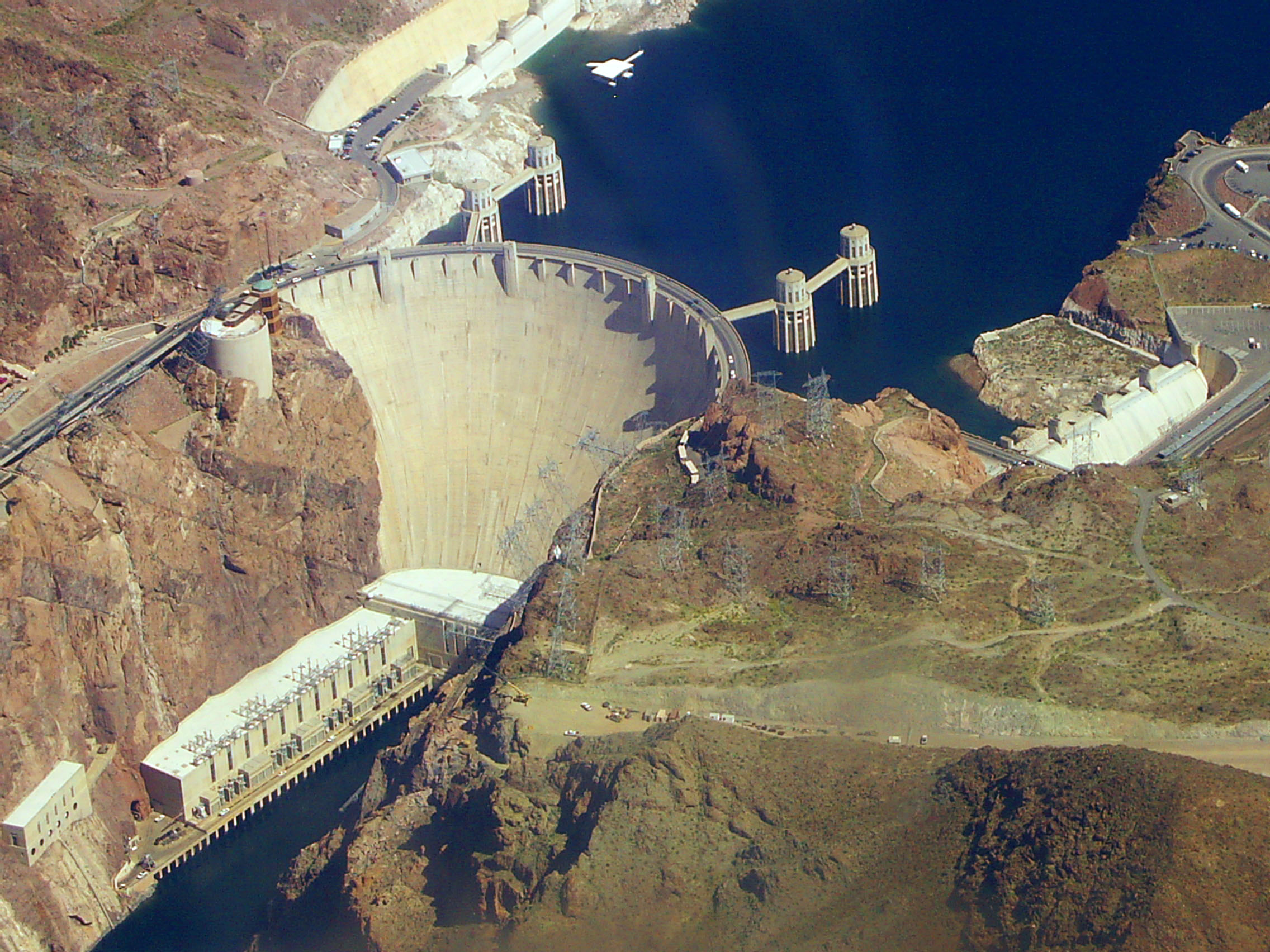
Here's a dam:


(Image from: http://en.wikipedia.org/wiki/File:Hoover_dam_from_air.jpg)
Here's another one:
(Image from: http://www.newswise.com/articles/beavers-dam-good-for-songbirds)
What differentiates the two? There are some obvious answers, like scale and building materials. There is, however, another answer that I think many people would give, and which I would argue isn't actually correct: one of these is natural and the other is not.
I disagree. I think they're both natural. In fact, in one sense, everything is natural. It is not possible for anything to be unnatural, because if it were, it wouldn't exist. Of course, this isn't, strictly speaking, the most accurate definition. But the nuance takes some time to explain. In the end, I want my reader to walk away thinking, "it's not useful to label things as natural or unnatural based solely on my gut reaction."
Wait, before you object, hear me out. This is initially going to sound like splitting hairs, but I think there are some very good reasons to reconsider our assumptions about what is natural and what is not. We often make judgements on whether something is good or bad based on snap assessments of whether or not that thing seems natural. But this is not a precise way of thinking, and doesn't let us understand the real reason something is "good" or "bad." If we want to be able to judge the value of our own behaviors, let us do it on a more solid understanding of the thing itself, not whether we feel that it's either natural or unnatural. It's too easy to get trapped in circular reasoning with this sort of thing. Why is this good? It's natural. What makes it natural? It feels good. What makes it feel good? It's so natural.
...
Most dictionary definitions of the word, "natural," include something like, "not caused or created by humans." While it is unarguably true that there exists "that which humans created and that which we did not," this definition creates a nice, neat, clean, and completely wrong-headed separation between humanity and nature.
This way of thinking probably has numerous origins, such as certain religious dogmas, the lengths that human beings specifically and (seemingly) consciously manipulate our surroundings to make ourselves physically removed/remote/insulated/safe from them, and undoubtedly, the way our brains are wired to perceive the world. In other words, to some extent, it's possible that we can't help but automatically see ourselves as separate from the "natural" world. We see two spheres of existence: the natural, and the human (or, by definition, the unnatural). Them and us. Like us and not.
The truth, of course, is that we are as much a part of nature, and as connected to it, as anything else on the planet. This seems childishly obvious, but it's easy to forget, especially if you happen to live in one of our concrete jungles and you never really spend time away from the city. Our particular development path, the western development path, lends itself to a very specific type of remoteness, where we're all several steps removed from the natural processes on which we rely. I don't necessarily see this as a problem, and this post is decidedly NOT about a need to "tear down civilization," but I do want to point out how the way we live influences our perception of what is natural. It's easier to feel like we're separate from the natural world when we're so far away from it in so many ways.
The point is that the dictionary is insufficient when it comes to thinking about natural and unnatural.
Back to the dams.
The beaver dam is natural. No arguments there.
What about the Hoover Dam? Not natural? Why not?
Well, because humans created it. Because of the scale. Because it fundamentally throws the entire surrounding ecosystem into a radically different equilibrium, and probably destroys a bunch of existing ecological niches in the process. These statements are all true, but I don't think that they make the Hoover Dam unnatural.
First, the existence of humans, the fact that we're here, is natural. We came to exist as a product of the same processes that created everything else. If you disagree with that assertion, then you may as well stop reading.
The point is that some things that people do are considered natural, even though this wouldn't fit the dictionary definition of the word. I don't think that there's anything fundamentally unnatural with, say, building shelter. Animals do it all the time. Would a lean-to seem unnatural? What about a house in the suburbs? Does one seem more natural than the other?
Here are the only differences between a lean-to and a house, between a beaver dam and the Hoover Dam: size, complexity, and the scale of the effects on the surrounding environment. It doesn't make sense to say that a behavior becomes unnatural when it passes a certain threshold in scale, nor do I think it makes sense to assert that some of our behaviors are natural and some are not. In the same way that a fox does what a fox does, humans do what humans do. Sure, the magnitude of the repercussions from our behavior is much greater, but that doesn't make our behavior unnatural. In summary, the simple fact of being human is not enough to make our behavior unnatural.
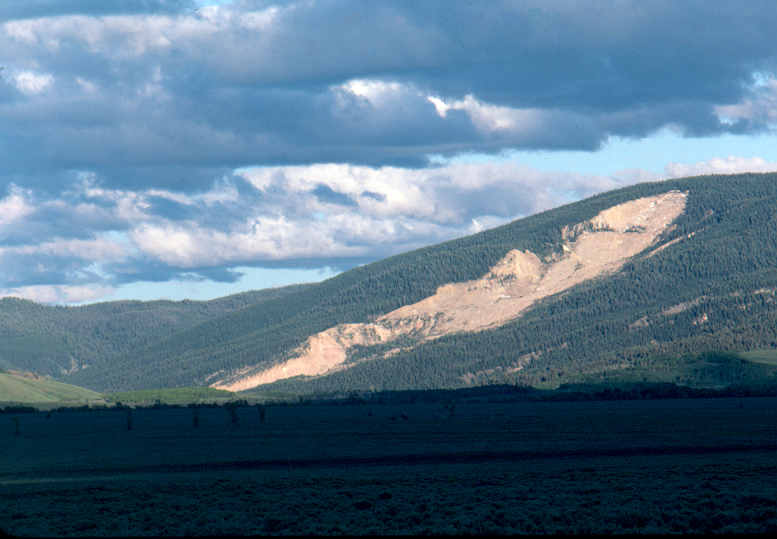
To address the topic of scale, consider the Gros Ventre landslide area near Jackson Hole. In the picture below, that enormous brown gash in the mountainside is where fifty million cubic yards of earth and rocks and trees used to reside. In 1925, due to heavy precipitation, that entire area relocated. Human action was in no way involved. I was there last summer, and you can still see where all that material used to be. The rubble blankets a gigantic area across the valley, even reaching up the slopes of the mountain opposite.
(Image from: http://www.nps.gov/grte/images/20091204133959.jpg)
The landslide created what are now called the Slide Lakes, seen in the image below. This picture was taken further up the valley from the picture above, facing the opposite direction. You can sort of make out the brown slide area stretching across the left side of the picture. Prior to the slide, the Gros Ventre river flowed unobstructed through the valley. I tried to find flow-rate data to give some idea of the river's size, but it wasn't available. As a very very very rough estimate, it's about 4 times the size of Boulder Creek during the spring runoff.

(Image from: http://www.jacksonholenet.com/lakes_rivers_falls/slide_lakes.php)
I don't know anyone who would argue that this landslide was unnatural, but the scale of the effects on the environment certainly rival that of many man-made dams. Clearly, it's not enough to argue that we affect the environment in a much bigger way than it would otherwise be affected if humans didn't exist.
Another potential way to define "unnatural" is to say that it throws off pre-existing equilibria. In response, natural processes recalibrate their equilibriums constantly; this happens whether humans are around or not.
So this leads us perhaps to the crux of the argument: would something happen if we took humans out of the equation? I think that many people like to use this question as the basic litmus test of naturalness. But if you agree that the existence of humans is natural, then this question is a logical fallacy. As long as the existence of humans is as natural as the existence of foxes (or what have you), then it doesn't make sense to ask that question. For example, we wouldn't ask, "would such-and-such still be natural if foxes didn't exist?" It's a moot point, because we automatically assume that since foxes are part of the "natural world," everything a fox does is natural.
But wait. Let's think about this a little more deeply.
To be fair, there's a little leeway here. If a fox started trying to survive by eating only grass seed, then we might say that it was behaving "unnaturally." But what does that mean? Only that it was behaving in a way that is 1) inconsistent with what we expect based on observing the behavior of other foxes, and 2) detrimental to its own interests, that is, its own survival.
A HA! Here is the one place where I think it's acceptable to apply the word, "unnatural."
Something is unnatural only if it's a self-inflicted action that directly inhibits our own ability to survive, and produces effects that cannot be mitigated/counteracted by reaching some new equilibrium.
But here's the kicker: such an action will, inevitably, stop. It literally cannot continue in the long run. The environment will force it to stop. This is why we so rarely see anything happening in nature that we'd characterize as "unnatural." Natural selection/environmental pressures stamped it out before we could notice. In this way, in the long run, everything that exists is natural, because if it weren't, it would be forced to end.
This is the only reliable way to gauge what is unnatural, but we automatically apply the term to a wide range of things that don't, in my opinion, deserved to be labeled as such.
The main problem I see is that we're not very good at deciding which of our behaviors are fundamentally "ok," or "good" (for our survival), and which are "not ok," or "bad." There are probably numerous things we do that we think are good, natural, and healthy (but aren't), and vice versa. I'm not sure that most people would call the process of synthesizing penicillin and putting it into little plastic pills "natural," but on the whole, that practice seems pretty useful for our survival.
To truly know whether we're enhancing our nest or fouling it, sometimes it's not enough to go with our gut feelings and call things natural or unnatural. Instead, we must do our best to realize how little we understand of the complexities of our environment, and wait to pass judgement until we understand the degree to which environmental equilibria will shift given a certain action, and whether we're prepared to accept (or even able to survive) the consequences of that shift.
Subscribe to:
Posts (Atom)